
The Storm Evolves in Lviv
A brief conversation with Konstantin Akinsha, co-curator of In the Eye of the Storm: Modernism in Ukraine, 1900-1930s, about the newest chapter of the exhibition.

As Lodestar East marks it one-year anniversary, I sat down with Konstantin Akinsha, the renowned curator, art historian, founder of the Avant-Garde Research Project, and author of The Daily Fake, to talk about the newest chapter of the award-winning exhibition he co-curated, In the Eye of the Storm: Modernism in Ukraine, 1900-1930s. Co-curated with Katia Denysova and first presented in 2022 at the Museo Nacional Thyssen-Bornemisza and most recently at the Muzeum Sztuki in Łódż, the exhibition has now arrived at the Andrey Sheptytsky National Art Museum in Lviv (NML). This latest iteration incorporates works from the NML’s own collection, offering fresh perspectives on the emergence of Ukrainian Modernism. At its core, the exhibition opens up a layered story, one where cultural identity, turbulent history, and a global art movement converge.
This exhibition has travelled and transformed across different venues. What elements did you choose to adapt for the Lviv iteration, and how do these changes speak to local audiences whilst remaining in dialogue with the show’s international versions?
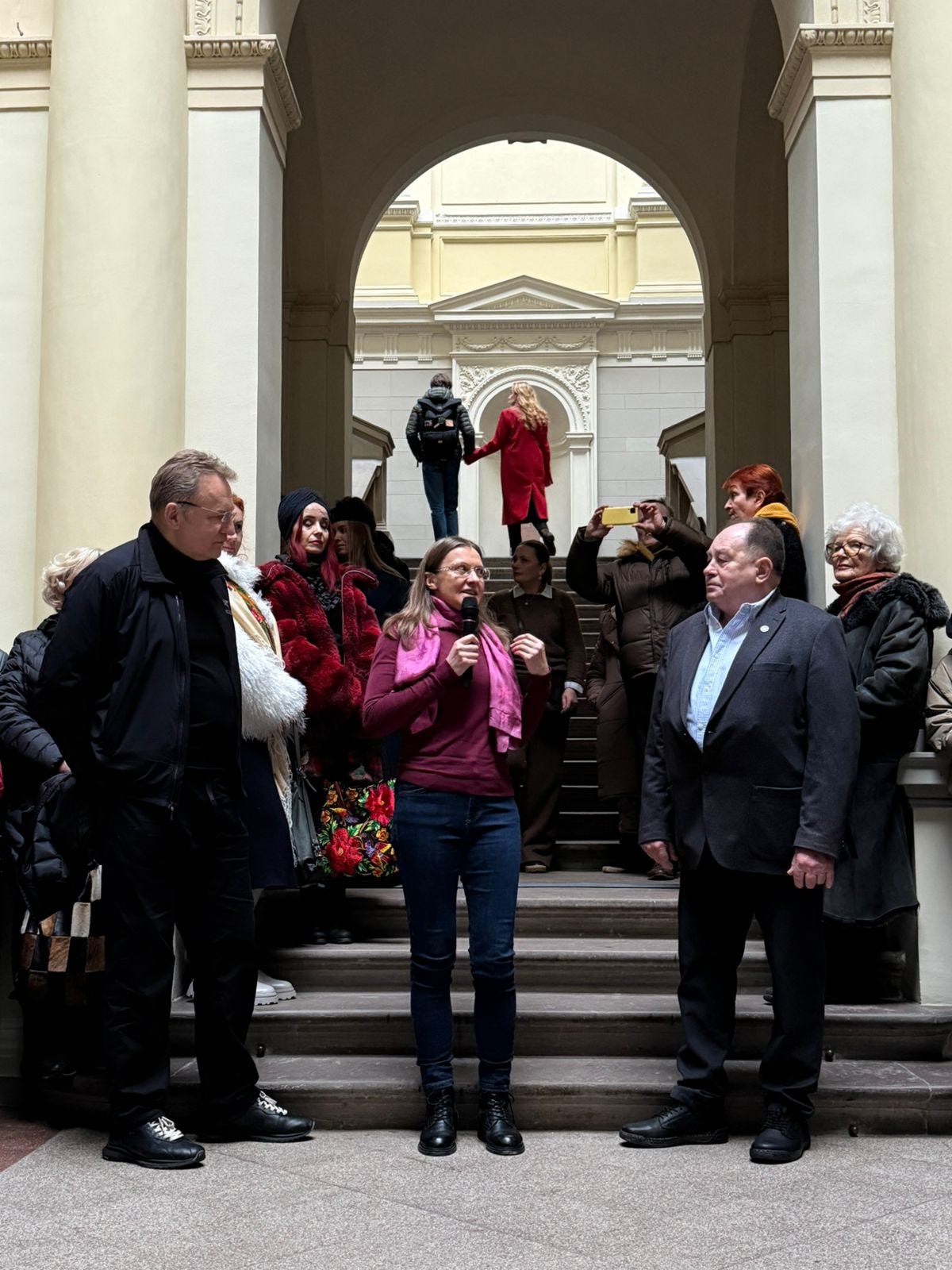
The exhibition has been changing from the very beginning because it was different in every place. In a sense, when we started this project, we put the cart in the front of the horse and started with the catalogue when we did not have a venue. The so-called catalogue monograph, the book from Thames and Hudson1, and we put more works in than we had in the exhibition. But it’s funny that after Madrid and other places, works were popping up, so still it became a kind of universal book, with one exception, because we did not have time and we did not have the means to look at the art in the western part of Ukraine. So geographically, the book was, let’s say, limited by the borders of the Ukrainian Republic between 1918 and, let’s say, 1939. So, works from western Ukraine, from Galicia, were lost. The Polish exhibition gave us a chance to add a substantial section with the artists from Lviv. Now we have redone this group on the artists from Lviv in Lviv. We basically replaced the section which was in Łódż with works from the collection of the Sheptytsky National Art Museum. I was very happy, as it was exciting for us to see what they have and some of the works which were included or were not included, obviously, could be utilised in the next project.
Modernism in Ukraine carries layers of interrupted histories, erased names, and rediscovered works. What responsibilities did you feel, as this exhibition returns to a Ukrainian museum context, in terms of how these stories are restored, represented or reinterpreted?
Talking about regional influences, of course, Ukraine is stuck between, if you want, East and West. It’s becoming like a banal metaphor, which is repeated all the time. But you have the Russian on one side and the Austro-Hungarian Empire on the other side. You have Poland, either Russian imperial or Austro-Hungarian imperial, as a kind of translator of Western influences. You have Munich and Paris, which were becoming increasingly important. You have Hungarians close on the border and all this sort of Western part, was really disregarded. This influence was different and instrumental, because even during the formation period–the 1900s–many of these artists are going either to study in Kraków, or to Vienna, or to Munich, and they are somehow becoming really part of this general central European…I cannot name it a school, but rather a trend. So, they’re looking, of course, at Moscow, but they’re more often looking at Kraków or Vienna. This story is repeated. It’s a kind of repetition of trends in Ukrainian art because if now were a different time and if in Hungary there were a different political situation, I could today put all my efforts into making an exhibition about the role of Hungarian Modernism in the formation of Ukrainian art of the 1960s. Because, with the end of the war, Ukraine received as a legacy, all these Carpathian-Ruthenian lands, which had a very, to my taste, distant relation to Ukraine. I’m talking about this part of historical Hungary, Ungvár, Munkács, et cetera. But together with these beautiful cities, they got some artists who were a part, a logical part, of Hungarian Modernists, like the later generation, such as [Jenő] Barcsay, [Tivadar] Kosztka.
The fact is that this Modernism, of course, in eastern Ukraine, it was nearly erased, and the only people who survived and started to reappear in the 1960s were
artists like [Vasyl] Yermilov, who received a second chance at life and came out with his brilliant late works. But in Transcarpathia, they were still painting Hungarian Modernist paintings in the style of the late 1930s. They were seen by, and they fully influenced, Tetiana Yablonska, who was trained by [Fedir] Krychevsky as a Socialist Realist and he found this to be an unbelievable, you know, door or window to the Western tradition, which had nothing in common either with Socialist Realism or, to be precise, this east Ukrainian tradition of Modernism. I mean, it was fully lost. But—and nobody is talking about it—there are many of these beautiful elements which still need serious research.
So, first was Madrid and you know all the obstacles with the Madrid exhibition; they already have been described and turned into folk legends. But to be precise, Madrid created the model for most of the museums. Madrid had their own material. They were changing labels on these Ukrainian artists in our presence, so the Burliuk brothers were Ukrainianised, and also Exter became Ukrainian. However, I never could understand the logic of emotional Ukrainianisation because according to... actually, I can understand the emotions, but not the logic. [Kazymyr] Malevych became, as you know, a Ukrainian artist, and we will die before we permit somebody to call him non-Ukrainian on the basis of the fact that he was born in Ukraine and he wrote, of course, an artist has—or anybody has— a right for self-identification. Malevych indeed wrote these memoirs, which [Nikolai] Khardzhiev forced him to write. Because if not for Khardzhiev, we never would have learned about the fact that he is Ukrainian, that he likes salo, and that he enjoyed all this folk art. So, he wrote it, he wants to be Ukrainian, he is Ukrainian. However, during his life, he was fully situationist and was becoming Polish in Poland and Russian when it was needed and Ukrainian when it was needed to be. The question is, ok, this is the basis. But what to do with [Victor] Palmov, who is a great Ukrainian artist, who is ethnic Russian, who was born in the Far East, in the area of Vladivostok, coming for the first time to Ukraine in 1922, if I am correct, or ’21, and just selecting Kyiv as his seat and becoming a fully integral part of this Modernist movement in Ukraine. What is to be done with Alexandra Exter, because we have constant discussions of who can claim her, because you know Exter is Jewish, Greek, from what is today [Belarus] and during that time the Kingdom of Poland, spent some content times in Kyiv, really became “the mother”. That is, if [Davyd] Burliuk became the father of Russian Futurism, she became obviously the mother of Ukrainian. But then she moved to Moscow and then she moved to Paris, and you have three Wikipedia articles which you can open: in French, she will be a French artist, in Ukrainian, a Ukrainian artist, in Russian, a Russian artist. So, it’s complicated. All of this, of course, dictated our initial petition, which I am repeating as a symbol of faith, that this exhibition is called not “Ukrainian Modernism”, but “Modernism in Ukraine”, and there is no Greek or Jew, so everybody who was there, who took part in the process, is entitled to be a part of the history of Ukrainian art.
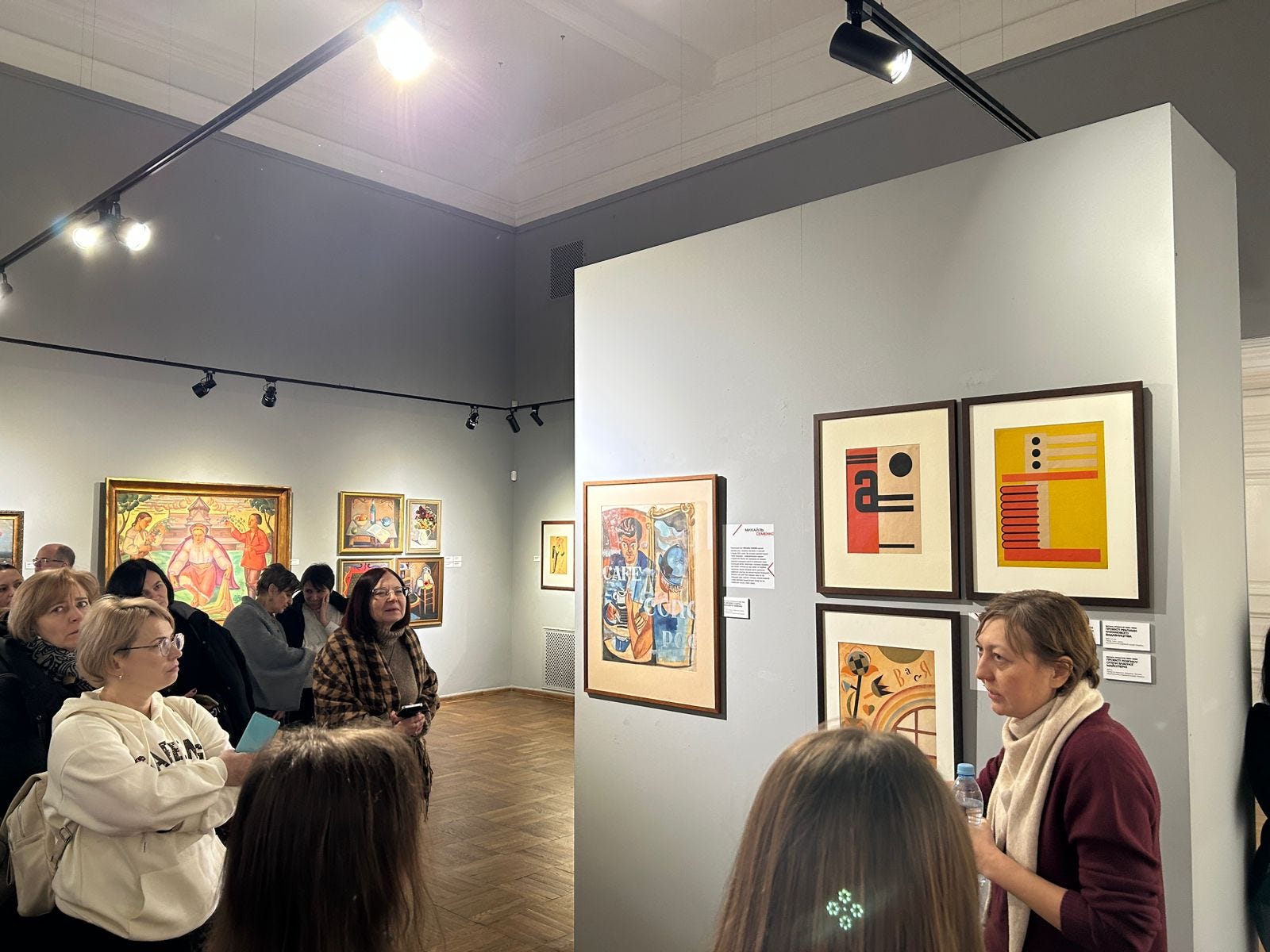
This has already created certain problems in Ukraine. We have the first clashes and first annoyance of some radical, to put it softly, idiots. Which is connected, of course, with an absolutely dangerous conception, called “Ukrainian avant-garde”, which was created by Mr. [Dmytro] Horbachov, and which became a little copy of Russian avant-garde, which is not a particularly smart term. I discussed it, as you probably saw, in the article which I wrote for the Cologne exhibition on fakes.2 I don’t like this term, but “Ukrainian avant-garde” became like a bad copy of the “Russian avant-garde”. As with the Russian avant-garde, I can say that in the Ukrainian avant-garde, half of those people are not Ukrainian and the other half were not avant-garde, because, of course, there is first the absence of stable ideological art groups. It’s not Russia. We did not have die-hard constructivists who were ready to break their heads open on principle, like, you know, as in this famous meeting of [Alexander] Rodchenko and Alfred Barr when Barr said, “But can you show me more paintings?” And Rodchenko said, “I don’t paint paintings.” Barr said, “Why?” Nobody! So that was absolutely this, I can say, approach, which was not typical for the Ukrainian situation. What we are seeing, in the majority of cases, is a really intriguing mutation of styles. Even one artist could reflect extremely different styles, like, for example, [Anatol] Petrytskyi. He’s painting— well, look, no explanation is needed. So, some of these artists are bordering, sometimes, with “Mannerism”, with what I’m calling “Modernist Mannerism”. It’s not a negative definition. It’s just a descriptive definition.
The only group, which is based on this ideological, “die-hard” ideology, are the Boichukists. When we in Ukrainian are endlessly calling the Boichukists “avant-garde”, it’s a parody because it’s a basically retrospective art from the very beginning. I think that there are many things to discuss, many things to compare, and to look at this, let’s say, course of Byzantium. We can see many ways it is connected to Kyiv initially and then taken to Kyiv by [Mykhailo] Boichuk, because we can go a little bit back and see the ideological project of Alexander III and the presence and construction of Vladimir Cathedral, the presence of [Mikhail] Vrubel in Kyiv, and then first Byzantinism, which Boichuk basically hijacked for his own needs. But to call it avant-garde is an absolute absurdity. It’s enough to go and to see his body first. Everybody likes to repeat that [Guillaume] Apollinaire himself noticed Boichuk’s works in Paris, but nobody wants to say what Apollinaire actually said about this work.
It’s extremely compelling material and, of course, we did the first various little steps trying to, you know, to collect the pieces and to connect the puzzle. There are still many things to do. It’s still fascinating also what we could not touch even chronologically: this formation of Ukrainian Socialist Realism, the second step after the late 1920s. There are thought-provoking elements of the story that have not been analysed deeply yet. So, our limit was chronologically focused. We tried to do this and even in the exhibition, we tried to, as much as we could, to involve loans, either from the local collections or a rotating selection of loans from private collections.


Which element of the exhibition do you hope visitors linger with longest? What conversation do you hope it sparks beyond the gallery?
For me, it is very interesting what the reactions of the exhibition will be. I was not at the opening, but Yulia Lytvynets [Director General of the National Art Museum of Ukraine] had the chance to go and I had the chance to take part in an online conference with some curators from the museum. Of course, it was light and complimentary; they simply were excited, because for them, it’s this exhibition that finally put the puzzle together.
We are doing this amidst challenging circumstances, and, you know, that traditional Ukrainian complaints about, let’s say, colonialism, et cetera, for which, to a certain extent, there is a reason. However, it’s taken too directly because I believe that Soviet colonialism is a different story. It’s not corresponding to any known classical models of colonialism. Because talking about the British Empire, your compatriots from Mumbai were not deciding who will be the next king in London and the Dnipropetrovsk clan in the Soviet Union was deciding such things. It’s a complicated, absorbing story. But there is one element of the story which is making me a bit annoyed. It was nearly 30 years of independence. So where have you been, my dear friends, my dear compatriots? Why did you not start to, let’s say, revisit and, let’s say, rethink the history of Ukrainian art before the first Russian bomb fall on your head? Which is an important issue, and this war is absolutely horrible, but it has absolutely restarted the process which had to be started some time ago. It’s a rethinking, it’s not without dangers, of course, what’s happening, because emotions are very high, but we are seeing the formation of, let’s say, the final formation of the narrative, which was absent. It’s a kind of serious exercise in the creation of, let’s say, the history of Ukrainian art. I think that this process is in the very beginning, but somehow it has started, and this is the extremely positive thing. It’s not an easy history of art to create because we have really great regional differences. Finally, in a sense, it could be compared to the United Kingdom because we have our Scotland, we have our Wales, we have our Northern Ireland. We are trying to glue all of this together now and this glueing together is quite complicated to understand because first there are different cultural influences, which were completely disregarded until 2022. Nobody talked about this, which is a big problem because these cultural influences have played a very funny role in the history of Ukrainian art.
In the Eye of the Storm: Modernism in Ukraine, 1900-1930s is at the Andrey Sheptytsky National Art Museum in Lviv, Ukraine, 22 February – 10 May 2026.
Curators: Katia Denysova, Konstantin Akinsha. Coordinators: Yulia Lytvynets, Maryna Drobotiuk, Oksana Bila, Oksana Zhmurko.
*This interview has been condensed and edited for clarity.
Resources:
A timeline on the cultural and historic events occurring in Ukraine during the period 1900-1930 can be found here (courtesy of Museum Ludwig).
Read about Saint Volodymyr’s Cathedral in Kyiv here.
Follow me on Instagram & Bluesky: @lwarnertreloar for the visual threads and small discoveries that don’t make it into the long-form essays.
Konstantin Akinsha, Katia Denysova, and Olena Kashuba-Volvach, eds. In the Eye of the Storm: Modernism in Ukraine, 1900–1930s. London: Thames & Hudson, 2022.
Russian Avant-Garde at the Museum Ludwig: Original and Fake Questions, Research, Explanations, Museum Ludwig, 26 September 2020-2 May 2021. Article on fakes: Konstantin Akinsha, “The Scourge of Russian Avant-Garde Fakes,” IFAR Journal 21, nos. 3-4 (2023). As the IFAR website is currently inaccessible, I refer here to the version of the summary hosted on James Butterwick’s website, accessed 26 March 2026.